
Introduction
The beverage industry is witnessing a massive shift toward PET cans (transparent plastic cans). They offer the premium look of glass, the convenience of aluminum, and allow consumers to see the fresh juice inside. However, packaging juice into PET cans at high speeds (e.g., 150 Cans Per Minute) presents severe engineering challenges: soft containers, oxidation risks, space constraints, and drying issues before labeling.
At Beyond Machinery, we don’t just supply standard machines; we engineer comprehensive turnkey solutions. In this article, we share how our Chief Engineering Team solves the most critical bottlenecks for top-tier beverage brands globally.
1. The Soft Container Challenge: Synergy of Juice Filling & LN2 Dosing
The Challenge:
Unlike traditional aluminum cans, PET cans are inherently soft. If a non-carbonated fresh juice is filled and sealed directly, the container lacks the internal pressure required to withstand stacking, palletizing, and transport. Furthermore, oxygen trapped in the headspace rapidly degrades the juice’s color, flavor, and Vitamin C.
The Engineering Solution:
We integrate an ultra-precise Inline Liquid Nitrogen (LN2) Doser strictly between the filling and seaming stations.
A micro-drop of -196°C Liquid Nitrogen is injected into the juice surface. It instantly vaporizes, expanding to 700 times its liquid volume. This physical reaction does two things simultaneously:
- Oxygen Displacement: It flushes out the ambient air in the headspace, extending the juice’s shelf life significantly.
- Rigidity: Once sealed, the trapped nitrogen gas creates internal pressure, turning the soft PET can as hard as a rock, making it 100% safe for cardboard cartoning and high-tier palletizing.
2. Mastering Double-Seam Integrity on Plastic Flanges
The Challenge:
Sealing a metal SOT (Stay-On-Tab) lid onto a PET plastic flange at high speeds is one of the highest-risk operations. If the double seam lacks micrometer-level precision, it results in low overlap or micro-cracks, leading to immediate leakage and product spoilage.
The Engineering Solution:
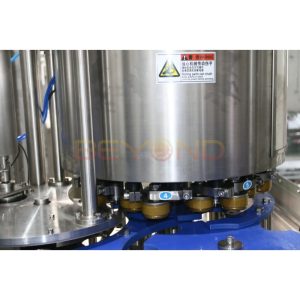
We refuse to use cheap, universal consumables. The heart of our Can Seamer—the Seaming Chucks and Rollers—are exclusively customized and imported from premium Taiwanese manufacturers.
Machined from high-hardness tool steel with specific surface treatments, these rollers ensure absolute micrometer-level precision. During our strict Factory Acceptance Test (FAT), we conduct full seam tear-downs and projection inspections to guarantee the Seam Thickness and Overlap perfectly meet international double-seam standards. Zero leakage is our baseline.
3. Overcoming Strict Factory Space Limits (The 15m Challenge)
The Challenge:
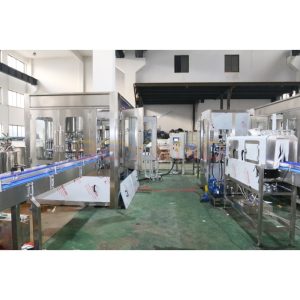
Many startup facilities or expanding plants have absolute spatial limits. We recently encountered a project requiring a complete filling, seaming, pasteurization, and drying line, but the customer’s site had a strict linear limit of 15.0 meters.
The Engineering Solution:
Shortening the pasteurization tunnel was not an option, as it would compromise the required holding time (PU value) and the 2000+ BPH capacity.
Instead, we broke the traditional straight-line thinking. We designed a customized “L-Shape” (90-degree turn) layout, incorporating Bi-directional Accumulation Tables.
- This not only perfectly fit the equipment into the 15m boundary but also provided a 3-to-5-minute buffer capacity. If a downstream packaging machine experiences a micro-stop, the accumulation table automatically absorbs the cans, ensuring the main Filler never stops and maintaining a world-class OEE (Overall Equipment Effectiveness).
4. The Drying Crisis: Getting Ready for Cartoning
The Challenge:
Even in an ambient temperature filling process, the exterior of the PET cans gets wet due to internal rinser splashing, micro-spills during high-speed filling, and the post-fill pasteurization spray. Standard axial fans cannot dry the concave bottoms of the cans, leading to ruined adhesive labels and soggy, damaged master cartons.
The Engineering Solution:
We engineered a specialized Dual-Track Air Knife Drying System. By splitting the conveyor into two tracks with a precise gap in the middle, high-pressure blowers drive air diagonally upward directly into the concave base of the PET cans. This guarantees 100% moisture removal, ensuring the product is perfectly dry and “Cartoning-Ready.”
Frequently Asked Questions (FAQs)
Q: How do you guarantee zero leakage when seaming metal lids onto PET cans?
A: The secret lies in the tooling. We exclusively use premium Taiwanese Seaming Chucks and Rollers made of high-hardness tool steel. This ensures the correct body hook and cover hook overlap, passing the strictest tear-down inspections without crushing the plastic neck.
Q: Why do I need an Air Dryer if I use an ambient filling process and my rinser only washes the inside of the can?
A: Even with internal rinsing and ambient filling, high-speed production causes inevitable micro-splashes and drips onto the can’s exterior. Furthermore, if your line includes a pasteurization or cooling tunnel, the cans emerge completely wet. If not aggressively blown dry by high-pressure air knives (especially the bottom recess), the wet surface will ruin label adhesion and destroy your cardboard carton packaging.
Q: Can you run PET cups and Aluminum cans on the same filling line?
A: Yes, absolutely. While capping mechanisms differ, we engineer custom monoblocks with quick-release star-wheels and guides to handle multi-format containers, minimizing changeover time and saving initial investment.
Ready to Build Your Custom Beverage Line?
Planning a new beverage packaging line or facing space, moisture, or multi-format packaging challenges? Don’t settle for off-the-shelf machines that don’t fit your engineering reality.
Contact Beyond Machinery’s Engineering Team today for a tailored 3D layout design and ROI analysis.

